
Tirupati Balaji: The Divine Form of Lord Venkateswara & His Significance
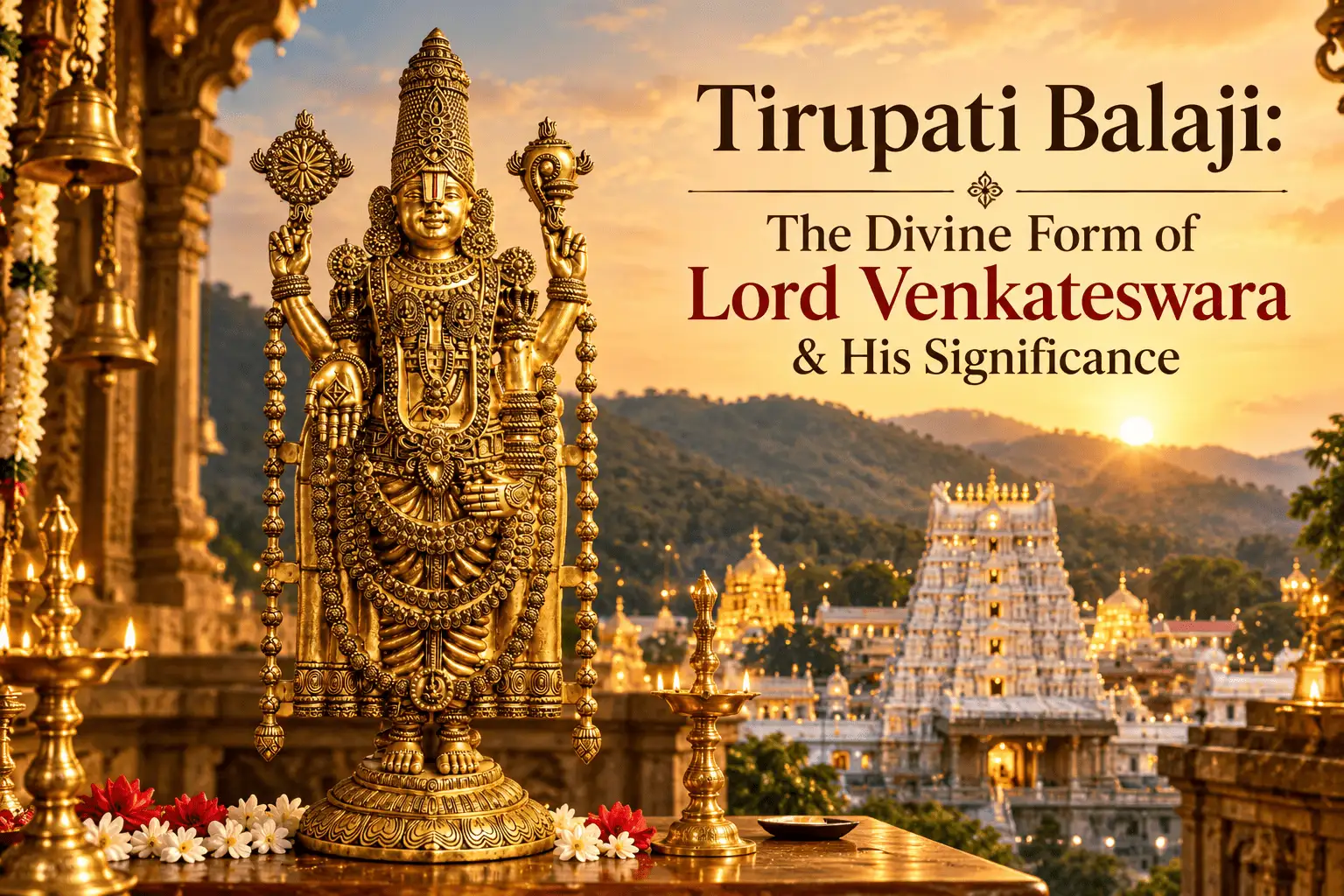
Tirupati Balaji: The Divine Form of Lord Venkateswara & His Significance
For millions of devotees, the sight of a tall crown, the sacred Tirunamam, the Shankha and Chakra, and the unmistakable standing posture immediately brings one name to mind — Lord Venkateswara of Tirumala.
He is lovingly called Tirupati Balaji, Srinivasa, Govinda, Venkatachalapati, Venkateswara Swamy and by several other devotional names. Yet behind these many names is one of the most distinctive and deeply revered forms of Lord Vishnu.
What makes the form of Tirupati Balaji so recognizable? Why does Lord Venkateswara stand with the Shankha and Chakra above, one lower hand directed towards His feet and another resting near His hip? Why is the Tirunamam such a defining feature of His appearance?
To understand Lord Venkateswara is not simply to learn the story of a famous temple. It is to understand a divine form that has inspired centuries of worship, sacred art, temple traditions and devotional craftsmanship.
Who Is Tirupati Balaji?
Tirupati Balaji is Lord Venkateswara, worshipped in the Vaishnava tradition as a form of Lord Vishnu.
His celebrated temple is situated at Tirumala, in present-day Andhra Pradesh. Tirumala Tirupati Devasthanams describes Sri Venkateswara as the presiding Lord of Venkatachala, or Venkata Hill, from which the name Venkateswara - Lord of Venkata Hill - is associated.
Although people commonly say “Tirupati Balaji,” the famous Sri Venkateswara temple itself is located on the Tirumala hills, while Tirupati is the city below.
For devotees, however, these geographical distinctions often merge naturally in everyday speech. “Tirupati Balaji” has become one of the most familiar ways of referring to Lord Venkateswara.
His presence at Tirumala is at the centre of an enormous living devotional tradition, expressed through temple worship, pilgrimages, chants of “Govinda,” festivals, songs and worship in homes far beyond Tirumala.
Why Is Lord Venkateswara Called Srinivasa, Balaji, Govinda and Venkatachalapati?
One of the beautiful aspects of Venkateswara devotion is the number of names by which devotees address Him.
Each name brings a slightly different devotional association.
Venkateswara
The name connects the Lord with Venkata Hill. TTD describes Him as Venkateswara because of His lordship over Venkatachala.
This makes the name inseparable from Tirumala itself.
Srinivasa
Sri is a name associated with Goddess Lakshmi, while nivasa conveys the idea of an abode or dwelling.
TTD religious publications explain the name Srinivasa through the presence of Sri Mahalakshmi on the Lord's chest — hence, He is understood devotionally as the abode of Sri.
Venkatachalapati
Venkatachalapati can be understood as the Lord of Venkatachala.
It is another name that directly connects the deity with His sacred hill abode.
Govinda
Anyone familiar with Tirumala will immediately recognize the cry:
“Govinda! Govinda!”
The name is deeply embedded in Venkateswara devotion and continues to be chanted by devotees during worship and temple celebrations. Even contemporary TTD accounts of festivals describe devotees chanting “Govinda” during processions.
Balaji
Balaji is another widely used devotional name for Lord Venkateswara, especially in popular usage across India. TTD itself identifies Lord Sri Venkateswara as also being known as Srinivasa, Balaji and Venkatachalapati.
Different names, therefore, do not indicate different deities here.
They are different ways through which devotees approach the same beloved Lord of Tirumala.
The Sacred Connection Between Lord Venkateswara and Tirumala
Lord Venkateswara cannot be separated from the identity of Tirumala.
The Sri Venkateswara Temple stands on Venkatachala, part of the sacred Seshachalam ranges. TTD identifies the temple with the seventh peak and describes Venkateswara as the “Lord of the Seven Hills.”
Temple tradition also closely connects Tirumala with Sri Varahaswami. According to the tradition recorded by TTD, Lord Srinivasa obtained land from Sri Varahaswami, and the longstanding practice of honouring Varahaswami before Sri Venkateswara continues at Tirumala.
These traditions make Tirumala more than simply the location of a temple.
For generations of devotees, the hill, the journey towards the sanctum, the cry of “Govinda,” and finally the darshan of Sri Venkateswara form one continuous devotional experience.
And at the centre of that experience is His extraordinary standing form.
Understanding the Divine Form of Lord Venkateswara
Even a simplified representation of Tirupati Balaji can often be recognized immediately.
That is because the traditional Venkateswara form has a powerful visual identity.
The upright standing posture, prominent crown, sacred forehead marking, Shankha and Chakra, characteristic positioning of the lower hands and elaborate ornamentation together create the form devotees associate with Tirumala.
Unlike a generic representation of Lord Vishnu, a traditional Venkateswara representation attempts to preserve this particular visual language.
The details are therefore more than decoration.
They help tell us who the deity is.
The Standing Form
Lord Venkateswara is characteristically represented standing upright.
There is a sense of stillness and majesty in the posture. Rather than relying on dramatic movement, the form draws attention through symmetry, verticality and the positioning of the hands and divine symbols.
When artisans reproduce Venkateswara in metal, stone or other traditional materials, maintaining this recognizable standing silhouette becomes particularly important.
Shankha - The Sacred Conch
The Shankha, or conch, is one of the best-known emblems associated with Lord Vishnu.
In the Venkateswara form, it appears with the upper hands and immediately helps establish the deity's Vishnu identity.
Because of its distinctive shape, the Shankha is also an important feature to examine when appreciating a detailed Venkateswara idol.
Chakra - The Divine Discus
Along with the Shankha appears the Chakra, the discus associated with Lord Vishnu.
Together, Shankha and Chakra form one of the strongest visual identifiers of Vishnu iconography.
In a carefully detailed representation of Lord Venkateswara, these elements should remain visually distinguishable rather than disappearing into the surrounding ornamentation.
Varada Hasta - The Lower Right Hand
One of the most interesting features of Lord Venkateswara's form is the position of the lower right hand.
It extends downward in Varada Hasta, directing attention towards the Lord's feet.
This gesture contributes significantly to the familiar silhouette of Tirupati Balaji.
For someone comparing Venkateswara idols, looking at the hands is therefore just as important as looking at the crown or facial detailing.
Kati Hasta - The Lower Left Hand
The lower left hand is positioned near the hip in the characteristic Kati Hasta posture.
Together with the downward-positioned right hand, this gives the standing form its unmistakable balance.
The two lower hands create a composition that devotees familiar with Tirumala can recognize even from a distance.
The Tirunamam
Perhaps no feature draws the eye more immediately than the sacred Tirunamam associated with the Venkateswara form.
Placed prominently on the forehead, it is an essential part of the visual identity through which generations of devotees recognize the Lord.
When Venkateswara is represented in an idol, painting or devotional image, the Tirunamam often becomes the visual centre of the face.
Combined with the crown, Shankha, Chakra and standing posture, it completes the instantly familiar image of Tirupati Balaji.
Explore the Divine Form of Lord Venkateswara
Once you know what to observe - the Tirunamam, Shankha, Chakra, standing posture, Varada Hasta and Kati Hasta - a Venkateswara idol can be appreciated at an entirely different level.
Rather than seeing only an ornamental statue, you begin noticing how each detail contributes to the traditional identity of the form.
Why Is the Form of Tirupati Balaji So Instantly Recognizable?
Recognition comes from a combination of features rather than a single symbol.
Imagine the silhouette without even seeing the finer details:
A tall standing deity.
A prominent crown.
The upper symbols of Shankha and Chakra.
One lower hand extending downward.
Another positioned near the hip.
A prominent Tirunamam.
Together they create a devotional visual language that has been reinforced through generations of temple worship, pilgrimage, paintings, calendars, sculptures and household shrines.
This is why craftsmanship matters when the form is reproduced.
The goal is not simply to add more ornamentation.
The more important challenge is to preserve the identity of Venkateswara within the details.
Lord Venkateswara and Purattasi
For many Vaishnava and Tamil Hindu families, Purattasi is a particularly significant period for Perumal worship, with Saturdays receiving special devotional attention in many households.
Lord Venkateswara therefore becomes an important devotional focus during the season.
Families may visit Perumal temples, recite prayers or names of Vishnu, light lamps, prepare traditional offerings and devote additional time to worship according to their family customs.
But Purattasi practices deserve their own explanation.
If you are specifically looking for the home-pooja procedure, preparation and items traditionally used during the season, read our separate guide:
→ How to Perform Purattasi Saturday Pooja at Home: Step-by-Step Rituals & Pooja Items
This article instead continues with the distinctive Venkateswara form itself and how it can be represented respectfully in a home pooja space.
Lord Venkateswara in a Home Pooja Space
A home pooja space does not need to reproduce the grandeur of a temple.
Its purpose is different.
A household shrine is a personal devotional space where an individual or family can pray and maintain their regular traditions.
For devotees of Perumal, a representation of Lord Venkateswara can become the central deity or form part of a larger pooja arrangement.
When selecting an idol, visual beauty matters — but practicality matters too.
Consider the available shelf height, the depth of the platform, the other idols already present and whether there is comfortable space around the Venkateswara idol.
The idol should feel proportionate to the shrine rather than crowded into it.
A compact pooja shelf may suit a smaller standing Balaji.
A larger dedicated pooja room can visually accommodate a taller and more intricately detailed form.
The important point is not simply to choose the largest idol possible.
Choose a form that can be placed, seen and worshipped comfortably in the space you actually have.
Find a Balaji Idol for Your Pooja Space
Before selecting a Venkateswara idol, consider:
Available height and width in your pooja shelf
Idol height
Standing-form proportions
Visibility of the Shankha and Chakra
Clarity of the Tirunamam and hand positions
Level of ornamentation and carving
Brass finish
Base stability
Proportion to your existing lamps and pooja articles
How Traditional Brass Craftsmanship Represents the Balaji Form
Brass has long been used in Indian devotional and decorative metalwork, making it a natural material for representing detailed deity forms.
Venkateswara is particularly interesting for a brass artisan because the identity of the deity depends upon numerous details working together.
The artisan must consider the proportions of the standing body, crown, ornaments, Shankha, Chakra, hands, Tirunamam and pedestal while maintaining a balanced overall composition.
With smaller idols, the challenge becomes even greater.
There is less physical space in which to communicate the defining features.
Larger idols allow additional detailing in jewellery, garments, surrounding elements and the base, while smaller Balaji idols often depend on a clean silhouette and clearly defined symbols.
The surface finish can also influence the appearance.
Traditional yellow-brass tones highlight the warmth of the metal, while antique-style finishing can bring additional visual depth to recessed carvings.
Neither automatically makes an idol more devotional than another.
They simply offer different ways of presenting the same traditional form.
This is why two Venkateswara idols of similar height can still look remarkably different.
Craftsmanship lies in how successfully the artisan balances recognition, proportion, detailing and finish.
Discover Traditional Brass Venkateswara Idols
When exploring a brass Venkateswara idol, look beyond the overall shine.
Observe how clearly the artisan has represented the Shankha, Chakra, crown, Tirunamam, Varada Hasta, Kati Hasta and standing form.
These details allow traditional brass craftsmanship to preserve the visual identity devotees associate with Lord Venkateswara.
How to Choose a Balaji or Venkateswara Idol for Home Pooja
Searching for a Balaji idol for home can produce hundreds of designs. Instead of selecting only by appearance, use a few practical criteria.
1. Start With Your Available Space
Measure your pooja shelf before choosing the idol.
Remember to account for the crown and pedestal rather than estimating only the height of the body.
Leave enough surrounding space so that lamps, flowers and other pooja articles do not make the arrangement feel congested.
2. Look for the Recognizable Standing Form
If you specifically want the familiar Tirupati Balaji appearance, look for a standing Venkateswara design that clearly preserves the characteristic posture.
3. Examine the Shankha and Chakra
These should remain visually identifiable.
On highly ornamented idols, check that important divine symbols have not become difficult to distinguish among decorative elements.
4. Observe the Hand Positions
The positioning of the lower hands contributes strongly to the Venkateswara identity.
Look for a clear representation of the downward Varada Hasta and the hand positioned near the hip.
5. Check the Tirunamam and Facial Detailing
Even in a small idol, these features can influence the overall character of the piece.
Look at photographs from more than one angle whenever possible.
6. Consider the Brass Finish
Some devotees prefer the brightness of traditional polished brass.
Others prefer a more antique appearance that emphasizes carved recesses.
Choose according to the visual character of your existing pooja setup rather than assuming that one finish is universally better.
7. Match the Idol With the Rest of Your Pooja Arrangement
A Venkateswara idol placed between large lamps may need enough visual presence to remain the focal point.
For a small shelf with compact lamps and pooja articles, a smaller idol may create better proportion.
A thoughtful pooja setup is often about balance rather than size.
Explore Venkateswara Idols from Magizh Handicrafts
Understanding the divine form changes the way we look at an idol.
The Shankha is no longer merely a carved shape.
The Chakra is not simply decoration.
The position of the hands is intentional.
The standing posture matters.
The Tirunamam matters.
And together, these details help a craftsman communicate the form that devotees recognize as Sri Venkateswara.
At Magizh Handicrafts, you can explore brass Balaji and Venkateswara idols across different sizes and traditional designs, allowing you to compare proportions, craftsmanship and detailing according to your pooja-space requirements.
Frequently Asked Questions About Tirupati Balaji
1. Who is Tirupati Balaji?
Tirupati Balaji is Lord Venkateswara, the presiding deity worshipped at the Sri Venkateswara Temple at Tirumala. He is also known by names including Srinivasa and Venkatachalapati.
2. Is Tirupati Balaji a form of Lord Vishnu?
Yes. Lord Venkateswara is worshipped within the Vaishnava tradition as a form of Lord Vishnu. The Shankha and Chakra visible in His traditional iconography are among the clearest visual connections with Vishnu.
3. Why is Lord Venkateswara called Srinivasa?
In the traditional explanation, Sri refers to Goddess Lakshmi and nivasa refers to an abode or dwelling. TTD religious literature connects the name Srinivasa with Sri Mahalakshmi residing on the Lord's chest.
4. Why is Lord Venkateswara called Balaji?
Balaji is one of the popular devotional names by which Lord Venkateswara is known. Usage varies by region, while names such as Venkateswara, Srinivasa, Govinda and Venkatachalapati are also widely associated with the same deity.
5. What are the most recognizable features of Lord Venkateswara?
The traditional Venkateswara form is particularly recognizable through its standing posture, crown, Tirunamam, Shankha, Chakra and characteristic lower-hand positions, including Varada Hasta and Kati Hasta.
6. Can a Venkateswara idol be kept in a home pooja space?
Venkateswara is widely worshipped in household pooja spaces. Individual families may follow their own sampradaya, customs or guidance regarding worship. From a practical standpoint, choose an idol that can be respectfully accommodated within a clean, dedicated pooja area.
7. How do I choose a Venkateswara idol for a home pooja room?
Begin with the dimensions of your pooja shelf. Then consider the idol's height, standing proportions, clarity of the Shankha and Chakra, hand positions, Tirunamam, brass detailing, finish and how the idol will visually balance with lamps and other items already present.
8. What is the connection between Lord Venkateswara and Purattasi?
Purattasi is traditionally associated with heightened Perumal/Vishnu devotion among many Tamil Hindu families, with Saturdays receiving particular devotional importance. Lord Venkateswara is therefore a major focus of worship during this period for many devotees. Specific observances vary according to family and regional traditions.
The Divine Form That Devotees Recognize at a Glance
Perhaps the most remarkable thing about Lord Venkateswara's form is how much meaning can be communicated before a single word is spoken.
The crown.
The Tirunamam.
The Shankha.
The Chakra.
The downward hand.
The hand at the hip.
The majestic standing posture.
For devotees, these elements come together as something far greater than an artistic composition. They form the familiar image of Sri Venkateswara — the Lord of Tirumala, remembered through generations of worship and devotion.
Understanding these details also gives us a deeper appreciation for the artisans who reproduce the traditional Balaji form in brass. A well-crafted representation is not simply about ornamentation; it is about preserving the visual characteristics through which devotees recognize the deity.
And when choosing one for a home pooja space, the best approach is equally thoughtful: understand the form, observe the craftsmanship, consider your available space and select a design that suits your devotional setting.
Explore Brass Balaji & Venkateswara Idols at Magizh Handicrafts
Discover brass Tirupati Balaji and Lord Venkateswara idols in different sizes and traditional designs at Magizh Handicrafts.
Compare the standing forms, craftsmanship, iconographic details and proportions to find a Venkateswara idol suited to your home pooja space or devotional gifting requirement.