
Navarathri: Significance, Nine Days of Worship & Pooja Traditions
Magizh HandicraftsPublished: October 13, 202611 min read
Discover the significance of Navarathri, the nine forms of Goddess Durga, and the beautiful traditions of this sacred Hindu festival. Explore Navadurga worship, Tamil Nadu Golu celebrations, Saraswati Pooja, Ayudha Pooja, traditional brass idols, and simple home pooja arrangements that bring devotion and cultural heritage together.
Navarathri: Significance, Nine Days of Worship & Pooja Traditions
INTRODUCTION
Discover the significance of Navarathri, the nine forms of Goddess Durga, and the traditional celebrations followed across India. Explore Navadurga worship, Tamil Nadu Golu traditions, Saraswati Pooja, Ayudha Pooja, and the role of brass idols and traditional lamps in home worship.
Navarathri: Significance, Nine Days of Worship & Pooja Traditions
Every year, Navarathri brings a special atmosphere into homes and temples. The glow of traditional lamps, colourful Golu arrangements, devotional songs and prayers to Goddess Amman create a celebration filled with faith, family traditions and cultural heritage.
But have you ever wondered why Navarathri is celebrated for nine nights? Why are different forms of the Goddess worshipped? And why do families arrange Golu dolls, light lamps and celebrate Saraswati Pooja during this festival?
Navarathri is more than a festival of decorations. It is a celebration of divine feminine power, devotion, knowledge and the victory of good over evil.
Let us explore the meaning of Navarathri, its nine days, the forms of Goddess Durga and the traditions that make this festival special.
What Is Navarathri and Why Is It Celebrated?
The word Navarathri comes from two Sanskrit words: Nava, meaning nine, and Ratri, meaning night.
The festival honours the Divine Mother, commonly worshipped as Durga, Lakshmi, Saraswati and other forms of Shakti.
One of the best-known traditions connects Navarathri with Goddess Durga's victory over Mahishasura, symbolising the triumph of righteousness over destructive forces.
Across India, the festival is celebrated in different ways. Some regions focus on Durga worship, others on the nine forms of Navadurga, while Tamil Nadu is especially known for Golu displays, devotional gatherings and Saraswati Pooja.
Although the customs differ, the central theme remains devotion to the Divine Mother.
The Nine Forms of Goddess Durga During Navarathri
In the Navadurga tradition, nine forms of Goddess Durga are honoured over the nine nights.
Each form has distinctive iconography and devotional significance.
Day 1 Shailaputri
Goddess Shailaputri is associated with the mountains and is traditionally depicted riding a bull, holding a trident and lotus.
She represents steadfastness and devotion.
Day 2 Brahmacharini
Goddess Brahmacharini is depicted carrying a rosary and a water pot.
Her form is associated with spiritual discipline, dedication and perseverance.
Day 3 Chandraghanta
Goddess Chandraghanta is recognised by the crescent-shaped ornament associated with her forehead.
Her powerful form represents courage and readiness to confront difficulties.
Day 4 Kushmanda
Goddess Kushmanda is associated in devotional tradition with cosmic creation and radiant energy.
She is commonly depicted with multiple arms holding symbolic objects.
Day 5 Skandamata
Goddess Skandamata is shown holding the child Skanda, also known as Lord Murugan or Kartikeya.
Her form reflects divine motherhood and nurturing care.
Day 6 Katyayani
Goddess Katyayani is a warrior form of Durga, often depicted riding a lion.
She is associated with courage and the struggle against injustice.
Day 7 Kalaratri
Goddess Kalaratri is known for her fierce appearance.
Her iconography represents the powerful aspect of the Divine Mother that confronts darkness and fear.
Day 8 Mahagauri
Goddess Mahagauri is traditionally associated with purity, serenity and spiritual renewal.
Her calm appearance contrasts with the fierce forms of the Goddess.
Day 9 Siddhidatri
Goddess Siddhidatri is associated with spiritual accomplishment and divine wisdom.
Her worship concludes the Navadurga sequence in many traditions.
Explore Traditional Amman Idols: Discover the artistic details and traditional representations of Goddess Durga and other Amman forms in the brass idol collections at Magizh Handicrafts.
Navarathri Celebrations in Tamil Nadu
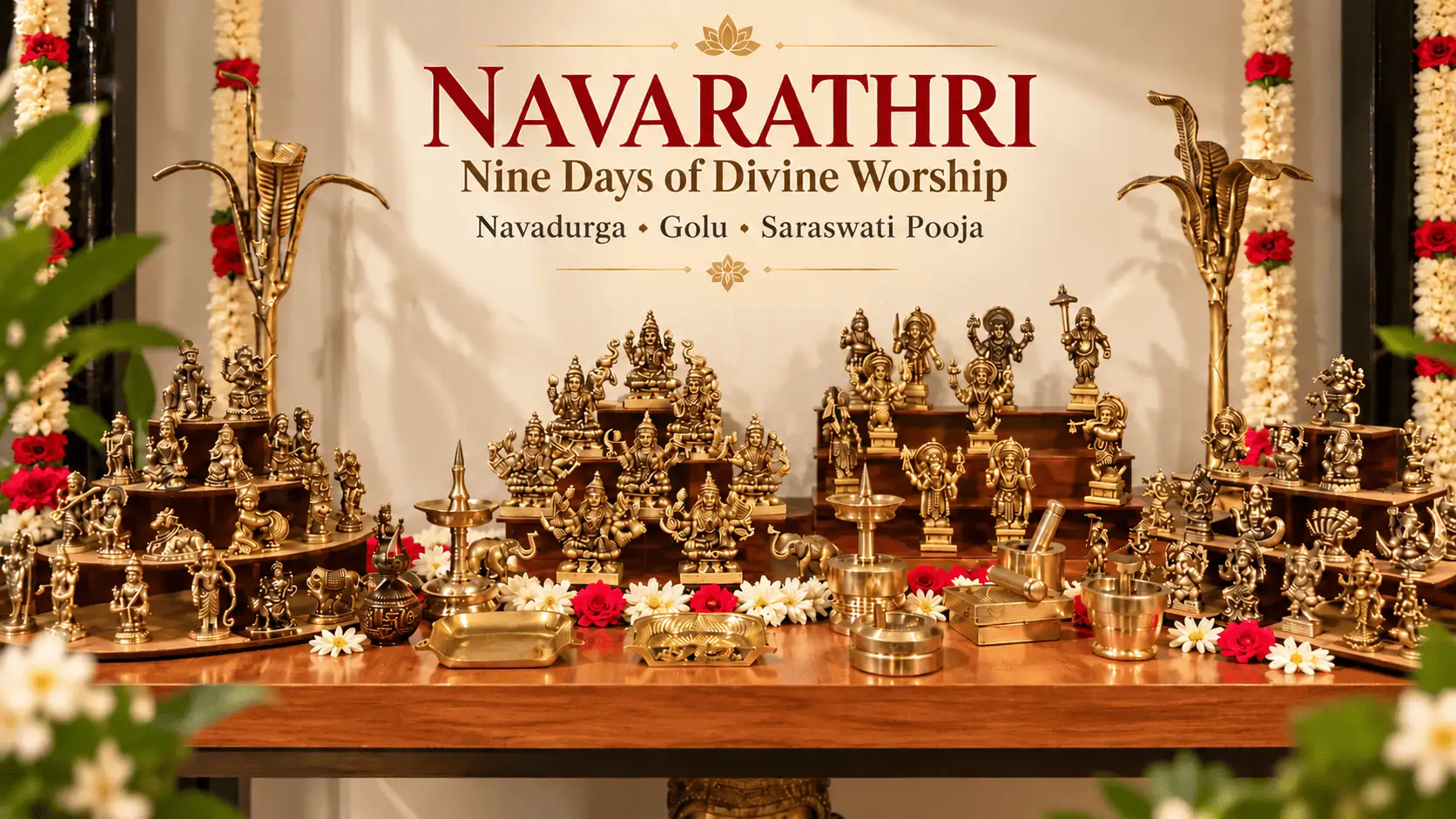
Tamil Nadu has a distinctive Navarathri tradition centred around the Bommai Golu.
Families arrange dolls and figurines on stepped displays, often using an odd number of steps.
These arrangements may include deities, saints, traditional scenes, animals, musicians and miniature representations of everyday life.
Golu is not simply decorative. It creates an opportunity for families to share stories, preserve cultural traditions and introduce younger generations to devotional practices.
Visitors are traditionally welcomed into homes to view the Golu, sing devotional songs and receive offerings such as sundal, depending on family custom.
Why Are Brass Idols Used in Navarathri Golu?
Brass idols have long been appreciated in Indian devotional settings for their durability, detailed craftsmanship and traditional appearance.
During Navarathri, brass representations of Goddess Durga, Lakshmi, Saraswati, Meenakshi Amman and other deities can become meaningful focal points in a Golu arrangement.
Their metallic finish and sculptural detailing complement traditional lamps, wooden platforms and colourful decorations.
When selecting an idol, families may consider its size, stability, detailing and suitability for the available Golu space.
Discover Brass Golu Idols: Explore traditional Goddess idols and miniature devotional figurines that can complement your Navarathri display.
The Significance of Lighting Lamps During Navarathri
Lighting a lamp is a familiar part of Hindu home worship.
In many devotional traditions, the flame symbolises knowledge, clarity and the removal of ignorance.
During Navarathri, families may light traditional lamps near the pooja area or Golu arrangement.
Brass Kuthu Vilakku, Pavai Vilakku and smaller pooja lamps are commonly appreciated for their traditional designs.
A carefully arranged lamp can also enhance the devotional atmosphere of a home.
Always place lamps on stable, heat-resistant surfaces, away from fabric decorations and other flammable materials.
Saraswati Pooja and Ayudha Pooja During Navarathri
Saraswati Pooja is an important part of the Navarathri celebrations in Tamil Nadu.
Goddess Saraswati is revered as the deity associated with knowledge, learning, music and the arts.
Families may respectfully arrange books, musical instruments and educational materials as part of the worship.
Ayudha Pooja honours tools, instruments, equipment and objects used in everyday work.
The observances reflect gratitude for knowledge, skills and the means through which people learn and earn their livelihood.
Specific dates and practices vary according to regional calendars and family traditions.
The Significance of Durga, Lakshmi and Saraswati During Navarathri
In many South Indian households, Navarathri is also celebrated through the worship of three important forms of the Divine Mother: Goddess Durga, Goddess Lakshmi and Goddess Saraswati.
A traditional interpretation associates the first three days with Durga, the next three days with Lakshmi and the final three days with Saraswati. However, the sequence and worship practices may differ according to regional and family traditions.
Goddess Durga represents courage, determination and the strength to overcome difficulties. Her worship encourages devotees to reflect on inner strength and righteous living.
Goddess Lakshmi is traditionally associated with prosperity, abundance and well-being. Her worship reminds families to value gratitude, generosity and the responsible use of resources.
Goddess Saraswati represents knowledge, wisdom, music and learning. Her worship highlights the importance of education, creativity and personal growth.
Together, these three forms reflect the traditional connection between strength, prosperity and wisdom.
Many families include Durga, Lakshmi and Saraswati idols or pictures in their Navarathri pooja arrangements to honour these aspects of the Divine Mother.
The Cultural Importance of Navarathri Golu
Navarathri Golu holds a special place in Tamil Nadu's cultural heritage because it brings together devotion, creativity and family participation.
Preparing a Golu display often becomes a shared family activity. Elders may explain the stories behind traditional dolls, while children help arrange miniature figurines, decorative elements and themed displays.
Some households preserve Golu dolls for many years, passing them from one generation to another. These collections may include representations of Hindu deities, traditional musicians, village scenes, animals and important characters from devotional stories.
The arrangement also provides an opportunity to appreciate traditional Indian craftsmanship. Brass idols, wooden figurines and handmade decorative pieces reflect different artistic practices.
During Navarathri, families may invite relatives, friends and neighbours to view their Golu arrangements. Devotional singing, the sharing of sundal and the exchange of small gifts are familiar customs in many homes.
Beyond its decorative beauty, Golu helps preserve stories, artistic traditions and a sense of community.
A thoughtfully arranged display, whether large or small, can become a meaningful part of the family's annual Navarathri celebration.
Vijayadashami and Its Connection to Navarathri
Vijayadashami, also known as Dussehra, marks the conclusion of the Navarathri festival.
The occasion is widely associated with the victory of good over evil. Different regions connect Vijayadashami with different devotional traditions, including Goddess Durga's victory over Mahishasura and Lord Rama's victory over Ravana.
In Tamil Nadu, Vijayadashami is considered an auspicious occasion for beginning educational and artistic activities.
Many families introduce young children to learning through a traditional ceremony known as Vidyarambham. Children may be guided to write their first letters as a symbolic beginning of their educational journey.
Some students also resume their studies, music practice or other learning activities after Saraswati Pooja.
The festival therefore carries a message that extends beyond celebration. It reminds devotees of the importance of knowledge, discipline, courage and meaningful new beginnings.
For families observing Navarathri at home, Vijayadashami offers an opportunity to conclude the celebrations with gratitude and renewed dedication.
Simple Navarathri Pooja Arrangements at Home
A beautiful Navarathri pooja setting does not require an elaborate display.
A family can create a meaningful devotional space using a few traditional items:
An image or idol of the Goddess
A clean pooja platform
A traditional brass lamp
Fresh flowers
Kumkum and turmeric, according to custom
A suitable plate for offerings
Fruits or homemade neivedyam
A small arrangement of Golu dolls, if desired
The arrangement can be adapted to the space available at home.
Explore Traditional Pooja Essentials: Discover brass lamps, pooja accessories and Goddess idols suitable for home worship at Magizh Handicrafts.
Traditional Neivedyam During Navarathri
Many Tamil households prepare different varieties of sundal during Navarathri.
Depending on family traditions, offerings may include chickpea sundal, green gram sundal, sweet preparations, fruits and other vegetarian dishes.
These offerings are prepared respectfully and shared as prasadam after worship.
There is no single universal menu followed by every household.
The type of offering, preparation method and daily custom may vary between families.
Choosing Traditional Idols for Your Navarathri Collection
When choosing an idol for Navarathri, it helps to consider both devotional preference and practical placement.
A compact brass Goddess idol may suit a small pooja shelf, while a larger representation may become the centrepiece of a dedicated Golu arrangement.
Look at the posture, ornaments, symbolic objects, base design and overall craftsmanship.
Different forms of the Goddess have different iconographic features. Understanding these details can make the selection more meaningful.
At Magizh Handicrafts, traditional brass idols and pooja accessories offer ways to appreciate the craftsmanship associated with devotional art.
The Importance of Devotional Music During Navarathri
Devotional music has an important place in Navarathri celebrations. In many South Indian households, families sing traditional songs, recite slokas and listen to devotional compositions dedicated to the Divine Mother.
Music is considered a meaningful expression of devotion because it allows people to connect with religious traditions through melody, rhythm and prayer.
During Navarathri, compositions dedicated to Goddess Durga, Lakshmi, Saraswati and other forms of Amman are commonly performed.
In Tamil Nadu, Carnatic music and traditional devotional songs are closely associated with Navarathri celebrations. Some families organise small musical gatherings where children and adults participate.
These gatherings encourage younger generations to appreciate classical music and traditional devotional literature.
Even simple devotional singing at home can create a peaceful atmosphere and make the celebration more meaningful.
Traditional Navarathri Decorations and Their Cultural Meaning
Decorations play an important role in creating a welcoming atmosphere during Navarathri.
Many families decorate their entrances with colourful kolam designs, fresh flowers and traditional mango leaf decorations.
Kolam designs are a familiar part of South Indian household traditions. During festivals, families may create elaborate patterns using rice flour or coloured powders.
Fresh flowers such as jasmine, marigold and roses are commonly used to decorate pooja spaces and devotional arrangements.
Mango leaf decorations, traditionally known as thoranam, are often displayed near entrances during auspicious occasions.
Brass lamps, traditional pooja plates and decorative vessels can complement these arrangements.
Families may choose simple or elaborate decorations depending on their available space and personal traditions.
The purpose of these decorations is not merely visual beauty. They also reflect hospitality, cultural identity and the care taken in preparing a devotional space.
How Navarathri Traditions Bring Families Together
One of the beautiful aspects of Navarathri is the opportunity it creates for families to spend meaningful time together.
Festival preparations often involve different generations working together. Elders share devotional stories, parents organise the pooja arrangements and children participate in decorations and cultural activities.
These experiences help preserve traditions that might otherwise become less familiar to younger generations.
Navarathri also encourages social connections. Visiting relatives, welcoming neighbours and sharing prasadam create opportunities for families and communities to interact.
For children, participating in these activities can introduce the significance of traditional festivals in an engaging way.
For adults, Navarathri offers a chance to reconnect with family customs and create new memories.
Whether celebrated through devotional music, simple prayers or family gatherings, Navarathri remains a meaningful occasion for strengthening cultural and family connections.
Frequently Asked Questions About Navarathri
1. What is the meaning of Navarathri?
Navarathri means nine nights. It is a Hindu festival dedicated to worshipping the Divine Mother in various forms.
2. Why are nine forms of Goddess Durga worshipped?
The Navadurga tradition honours nine distinct forms of the Goddess, each associated with particular qualities and devotional meanings.
3. What is Navarathri Golu?
Golu is a traditional stepped display of dolls and figurines, especially popular in Tamil Nadu during Navarathri.
4. Which Goddess is worshipped during Saraswati Pooja?
Goddess Saraswati, associated with knowledge, music, learning and the arts, is worshipped during Saraswati Pooja.
5. Can brass idols be used for Navarathri Golu?
Yes. Brass idols are commonly suitable for devotional displays and Golu arrangements, provided they are placed securely.
6. What food is traditionally offered during Navarathri?
Different varieties of sundal, fruits and sweet preparations are common in many households. Offerings vary by family tradition.
7. Is a large Golu arrangement necessary?
No. A small, thoughtfully arranged devotional display can be suitable for families with limited space.
8. Which traditional lamps can be used during Navarathri?
Families may use Kuthu Vilakku, Pavai Vilakku or smaller pooja lamps according to their customs and available space.
Conclusion: Celebrating Navarathri with Devotion and Tradition
Navarathri brings together devotion, craftsmanship, family gatherings and cultural heritage.
From the nine forms of Goddess Durga to Golu displays, Saraswati Pooja and the lighting of traditional lamps, every aspect of the celebration reflects a meaningful tradition.
Whether your home has an elaborate Golu or a simple pooja arrangement, the festival offers an opportunity to appreciate the Divine Mother and share devotional customs with the next generation.
Visit www.magizhhandicrafts.com to explore our traditional handicraft collect