
Forms of Perumal: Lord Vishnu Forms & Their Significance
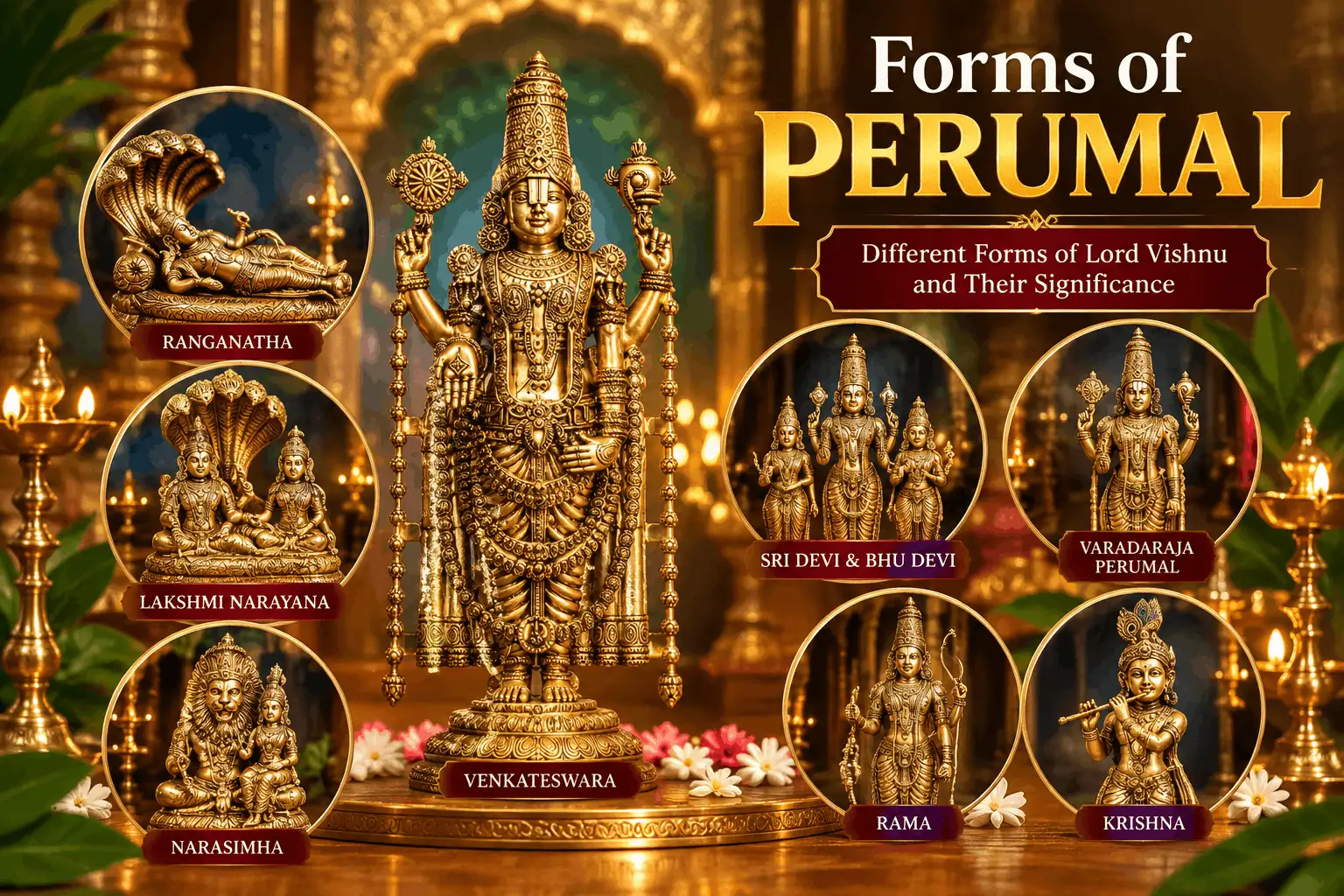
Perumal is worshipped through many beloved names, forms and manifestations, each with its own iconography and devotional tradition. Explore well-known forms associated with Lord Vishnu - from Venkateswara and Ranganatha to Varadaraja, Narasimha, Rama and Krishna and understand what makes each representation distinctive.
Forms of Perumal: Lord Vishnu Forms & Their Significance
When you hear the names Perumal, Vishnu, Narayana, Venkateswara, Ranganatha or Varadaraja, you may wonder: are these different gods, different forms of the same deity, or simply different names used in different traditions?
It is an interesting question because the answer is more nuanced than simply listing “forms of Perumal.”
In Vaishnava traditions, Lord Vishnu is worshipped through different names, manifestations, avatars, temple forms and iconographic postures. Some representations show the Lord standing majestically, others reclining on Adisesha, while particular temples are associated with distinctive names and traditions.
Understanding these differences can make temple visits, home worship and even the selection of a Perumal idol for a pooja room more meaningful.
Let us explore some of the best-known representations associated with Perumal and understand what makes each one distinctive.
Who Is Perumal?
Perumal is a widely used devotional name for Lord Vishnu, particularly within South Indian Vaishnava traditions.
Lord Vishnu is one of the principal deities of Hindu tradition and is worshipped under numerous names and manifestations. Narayana, Srinivasa, Venkateswara, Govinda, Ranganatha and Varadaraja are among the names devotees may encounter in temples, prayers and devotional traditions.
However, an important distinction should be kept in mind.
Not every name of Vishnu represents a separate avatar.
A name may refer to a particular quality or title of the deity, an iconographic representation, a manifestation associated with a temple, or an avatar described within a religious tradition.
This is why understanding the different forms of Perumal is about more than memorising a list of names.
Why Does Perumal Appear in Different Forms?
Hindu devotional traditions use sacred images and iconography to express different theological ideas and narratives.
For example, a Vishnu murti may be shown:
Standing
Seated
Reclining on Adisesha
With Sri Devi and Bhu Devi
With traditional attributes such as the Shankha and Chakra
In a particular temple-associated manifestation
Through avatars such as Rama, Krishna or Narasimha
These visual differences help devotees recognise the particular representation before them.
The details can vary according to temple tradition, Agamic practice, artistic convention and sampradaya.
So, rather than treating every Perumal murti as identical, it is useful to notice its posture, accompanying deities, hand positions, ornaments and other iconographic features.
Well-Known Forms and Manifestations Associated with Perumal
1. Venkateswara – The Famous Standing Form of Perumal
Among the most recognisable forms of Perumal is Sri Venkateswara, closely associated with Tirumala.
The deity is also lovingly addressed by names such as Srinivasa, Balaji and Govinda in different devotional contexts.
In the traditional Venkateswara representation, the Lord appears in a majestic standing posture with elaborate ornaments and a distinctive vertical Vaishnava namam.
This immediately recognisable iconography has made the Venkateswara idol one of the most familiar choices for Vishnu devotees.
For a home pooja space, devotees who feel particularly connected to Tirumala or Sri Venkateswara traditions may choose a brass Venkateswara idol as their central deity.
Explore: Brass Perumal and Venkateswara Idols from Magizh Handicrafts.
2. Ranganatha - Perumal in the Reclining Form
One of the most visually distinctive representations of Lord Vishnu is Sri Ranganatha.
Unlike the standing image of Venkateswara, Ranganatha is traditionally represented reclining upon Adisesha, the divine serpent.
This form is famously associated with Sri Ranganathaswamy temples and is immediately identifiable because of its reclining posture.
Depending on the representation, other divine figures may also form part of the composition.
A Ranganatha idol can therefore be quite different visually from a conventional standing Perumal idol. Its elongated composition and detailed serpent couch also make it an impressive example of traditional devotional craftsmanship.
3. Varadaraja Perumal
Sri Varadaraja Perumal is another revered manifestation of Lord Vishnu and is particularly associated with the famous Varadaraja Perumal Temple at Kanchipuram.
The name Varadaraja is commonly understood in the sense of the “king or lord who grants boons.”
Traditional representations usually show Varadaraja Perumal standing majestically with recognisable Vaishnava iconography.
For someone exploring different Perumal statues, the Varadaraja representation provides another example of how a particular manifestation can develop its own strong temple identity and devotional tradition.
4. Lakshmi Narayana - Vishnu with Goddess Lakshmi
Another popular representation is Lakshmi Narayana, in which Lord Vishnu is represented together with Goddess Lakshmi.
This form visually brings the divine couple together within a single composition.
Depending on the sculptural tradition, Goddess Lakshmi may be shown seated alongside Lord Vishnu or incorporated into a more elaborate composition.
A Lakshmi Narayana brass idol can be especially suitable for devotees who prefer a combined representation of Vishnu and Lakshmi in their home pooja room.
When choosing such an idol, look closely at the posture, detailing of the divine figures, pedestal and overall proportions, as these can differ considerably between designs.
5. Narasimha - The Man-Lion Avatar of Vishnu
Narasimha needs an important distinction: Narasimha is traditionally understood as an avatar of Lord Vishnu, rather than simply another title of Perumal.
Narasimha is represented with a human-like body and a lion-like face, making the form instantly recognisable.
There are also different iconographic representations of Narasimha. One commonly seen devotional representation is Lakshmi Narasimha, where Goddess Lakshmi accompanies Narasimha.
6. Rama - An Avatar of Vishnu
Sri Rama is traditionally regarded as an avatar of Lord Vishnu.
Rama iconography is quite different from a conventional standing Vishnu or Venkateswara murti. He is commonly represented holding a bow, and devotional sets may include Sita, Lakshmana and Hanuman.
This distinction demonstrates why “forms of Perumal” and “avatars of Vishnu” should not always be used as interchangeable expressions.
Someone specifically seeking a Rama idol may therefore be looking for a very different devotional composition from someone searching for a traditional Perumal or Venkateswara idol.
7. Krishna - Another Beloved Avatar of Vishnu
Sri Krishna is another major avatar associated with Vishnu traditions.
Krishna himself appears through many familiar devotional representations, including:
Bala Krishna
Venugopala Krishna
Krishna with Radha
Krishna with a cow
Guruvayurappan-inspired representations
Krishna playing the flute
This creates another layer within Vishnu iconography: one avatar can itself be represented through several devotional scenes and stages of life.
For home décor or a pooja space, brass Krishna idols are available in many compositions, making it useful to choose according to the particular Krishna representation meaningful to your household tradition.
Standing, Seated and Reclining Forms of Vishnu
One simple way to understand Perumal iconography is through posture.
Standing Perumal
Standing forms often create a tall, symmetrical and majestic appearance.
Venkateswara and several temple manifestations of Vishnu are familiar examples of standing representations.
For a pooja room with limited shelf depth, a standing brass Perumal idol can also provide a strong visual presence without requiring the horizontal space of a reclining composition.
Seated Vishnu
Seated Vishnu representations offer a different composition, sometimes accompanied by Sri Devi and Bhu Devi or Goddess Lakshmi depending on the iconography.
The seated posture changes the proportions of the murti and can work particularly well in compact home mandirs.
Reclining Vishnu
The reclining form is strongly associated with representations such as Ranganatha, where Vishnu rests upon Adisesha.
Because the composition extends horizontally, a reclining Perumal idol generally requires a wider pooja shelf or display area.
When selecting an idol, therefore, understanding the posture is useful not only devotionally but also practically.
Perumal with Sri Devi and Bhu Devi
Another beautiful representation frequently seen in Vishnu worship is Perumal with Sri Devi and Bhu Devi.
Rather than a single central figure, these idols create a three-deity composition with Perumal at the centre.
This style is particularly attractive for a dedicated pooja room because the complete arrangement is incorporated into one coordinated sculpture or idol set.
When selecting a brass Perumal with Sri Devi and Bhu Devi idol, consider:
Overall height
Total width
Facial detailing
Hand attributes
Ornamentation
Pedestal design
Available pooja shelf space
The correct choice is not necessarily the largest idol. An appropriately proportioned idol that fits the pooja space comfortably can create a much more balanced setup.
Perumal, Venkateswara and Balaji - Are They the Same?
This is one of the most common points of confusion when shopping for a Perumal idol.
Perumal is a broader devotional name associated with Vishnu.
Venkateswara refers specifically to the manifestation of Vishnu associated with Tirumala.
Balaji is another widely used name for Venkateswara.
Srinivasa and Govinda are also names strongly associated with Venkateswara devotion.
Therefore, when browsing idols online, you may find similar-looking products listed under terms such as:
Brass Perumal Idol
Brass Venkateswara Idol
Brass Balaji Idol
Brass Srinivasa Idol
Tirupati Balaji Brass Idol
The exact sculpture should always be checked rather than assuming that every product using these search terms has identical iconography.
Perumal Forms vs Dashavatara - What Is the Difference?
Another useful distinction is between the forms or manifestations of Perumal and the Dashavatara of Vishnu.
Dashavatara refers to a traditional grouping of ten avatars of Vishnu. Lists and interpretations can vary between traditions.
By contrast, names such as Venkateswara, Ranganatha and Varadaraja are better understood within their respective Vishnu/Perumal manifestations and temple traditions rather than simply being added to the Dashavatara list.
Similarly, Rama, Krishna and Narasimha belong to avatar traditions.
Understanding this distinction prevents all Vishnu-related names from being incorrectly grouped into one category.
How to Choose a Perumal Idol for Home Pooja
With so many different Perumal representations available, choosing one can initially seem difficult.
A practical approach is to begin with the form your family already worships or feels connected to.
Consider the Form
Would you prefer:
Venkateswara?
Perumal with Sri Devi and Bhu Devi?
Lakshmi Narayana?
Ranganatha?
Narasimha?
Rama?
Krishna?
Start with the devotional representation rather than choosing solely based on appearance.
Check the Available Space
Measure the pooja shelf before selecting the idol.
Consider:
Height × Width × Depth
This becomes especially important for wide compositions such as Ranganatha or multi-deity sets.
Look at the Details
Traditional brass idols can contain significant sculptural detail.
Examine:
Facial features
Crown
Ornaments
Shankha and Chakra
Hand positions
Accompanying deities
Adisesha where applicable
Pedestal and base
These details can help you identify the representation more accurately.
Choose the Material and Finish
A brass Perumal idol offers the visual character of traditional metal craftsmanship and is available in different sizes and finishes.
Choose a piece based on the intended pooja space, preferred appearance and ease of placement rather than assuming that one size or finish is suitable for every home.
Creating a Simple Perumal Pooja Setup at Home
A home pooja setup does not need to be overcrowded.
A thoughtfully arranged space may include:
A central Perumal or Vishnu idol
A traditional brass lamp
A small plate or tray for offerings
Flowers according to household practice
Incense or other pooja essentials according to preference
A clean backdrop
If your pooja area is compact, avoid filling every available space with objects.
Allowing some space around the central deity can make the arrangement appear more peaceful and organised.
For a larger pooja room, devotees may choose a more detailed Perumal with Sri Devi and Bhu Devi composition along with traditional brass lamps on either side.
Why Understanding the Form Matters When Buying an Idol
Two brass idols may both be described casually as “Perumal,” yet their actual iconography can be completely different.
One might depict Venkateswara.
Another may show Perumal with Sri Devi and Bhu Devi.
A third could represent Ranganatha reclining on Adisesha.
Another may be Lakshmi Narayana.
Understanding the representation helps you choose an idol that actually matches what you are looking for.
This is particularly important when shopping online, where product names, photographs, measurements and descriptions should all be checked before purchasing.
Frequently Asked Questions About Forms of Perumal
1. Who is Perumal?
Perumal is a devotional name widely used for Lord Vishnu, especially within South Indian Vaishnava traditions. Different names and temple manifestations of Vishnu are also worshipped within these traditions.
2. Is Venkateswara a form of Vishnu?
Yes. Sri Venkateswara of Tirumala is worshipped as a manifestation of Lord Vishnu and is also widely known by names such as Srinivasa, Balaji and Govinda.
3. Is Ranganatha a form of Vishnu?
Yes. Ranganatha is the reclining representation of Lord Vishnu, traditionally depicted resting upon Adisesha.
4. Are Perumal and Venkateswara the same?
Perumal is a broader devotional term for Vishnu, while Venkateswara refers specifically to the well-known manifestation associated with Tirumala.
5. Are all forms of Perumal avatars of Vishnu?
No. This distinction is important. Names, temple manifestations, iconographic forms and avatars are not necessarily the same category. Rama, Krishna and Narasimha are traditionally regarded as avatars, whereas names such as Venkateswara, Ranganatha and Varadaraja have their own manifestation and temple contexts.
6. Which Perumal idol is suitable for home pooja?
There is no single Perumal representation that every household must choose. Families may select Venkateswara, Lakshmi Narayana, Perumal with Sri Devi and Bhu Devi, Ranganatha or another Vishnu-related representation according to their devotional tradition, preference and pooja-space requirements.
7. Can I keep a brass Perumal idol in my pooja room?
Brass Perumal idols are commonly selected for home pooja spaces. Choose an appropriate form and size for your available space and follow the worship practices observed by your family or spiritual tradition.
8. What should I check before buying a Perumal idol online?
Check the exact deity representation, material, height, width, weight where available, iconographic details, finish and product photographs. For multi-deity or reclining idols, pay particular attention to the total width and depth.
Discover the Form of Perumal That Speaks to Your Devotion
The beauty of Vishnu worship is reflected in its rich variety of names, avatars, manifestations and sacred representations.
From the majestic standing form of Venkateswara to Ranganatha reclining upon Adisesha, the temple-associated identity of Varadaraja, the combined representation of Lakshmi Narayana, and avatars such as Narasimha, Rama and Krishna, each introduces devotees to a different aspect of a vast devotional tradition.
Understanding these distinctions can also help you recognise what you are seeing in a temple or choose a more appropriate idol for your home pooja space.
At Magizh Handicrafts, explore traditional brass Perumal, Venkateswara, Vishnu and other devotional idols crafted in a variety of designs and sizes for home pooja spaces and devotional gifting.
Explore the Perumal Collection → Find a Brass Perumal Idol for Your Pooja Space