
Lord Ayyappan: Significance, 41-Day Viratham, Sabarimala & Home Pooja Guide
Magizh HandicraftsPublished: November 26, 202612 min read
Discover the significance of Lord Ayyappan, the story of Manikandan and the meaning behind his seated posture. Learn how devotees prepare for Sabarimala through the 41-day Viratham, what Mandala Pooja and Makaravilakku mark, and how to perform a simple home pooja and choose a traditional brass Ayyappan idol.
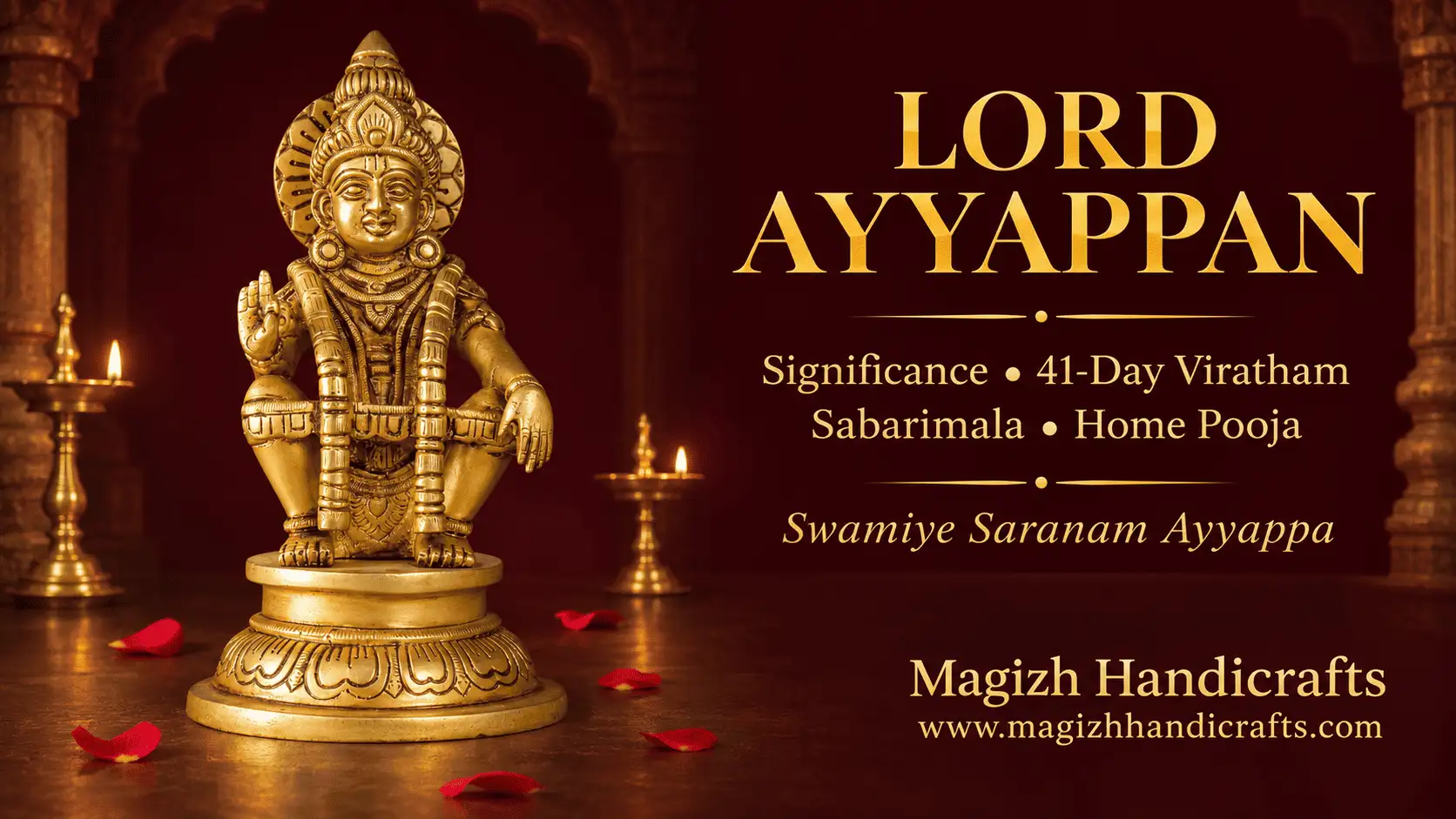
Swamiye Saranam Ayyappa is a devotee’s call of surrender: “Lord Ayyappa, I take refuge in you.” At Sabarimala, pilgrims call it out as they walk together. At home, the same words can be spoken quietly before a lamp. Both expressions of devotion to Lord Ayyappan carry a commitment to humility, self-control and care for others.
That commitment shapes the 41-day Mandala Viratham, the journey to Sabarimala and the simple rituals many families follow during the Tamil month of Karthigai. The story of Manikandan, the deity’s seated form and the preparations pilgrims make all help explain why this season means so much to devotees.
Lord Ayyappan, also known as Lord Ayyappa, is worshipped across Kerala, Tamil Nadu and other parts of South India. At Sabarimala, he is venerated as Dharma Sastha and as a Naishtika Brahmachari, a deity in perpetual celibacy. Devotees associate him with righteous conduct, self-restraint and protection. Sastha traditions across South India include several forms and local interpretations, so the story and iconography familiar at Sabarimala may differ from those at another shrine. Kerala Tourism’s guide to Sabarimala
In the traditional account, Ayyappan is born to Lord Shiva and Mohini, the female manifestation of Lord Vishnu. The king of Pandalam finds the child with a bell or jewel at his neck and raises him in the royal household as Manikandan. The child grows up as a prince, and his journey into the forest brings him face to face with Mahishi, whom he defeats.
A widely told version connects this journey with a request for tigress’s milk. Manikandan returns riding a tiger, and the people of Pandalam recognise his divine identity. The story links him with the hill shrine at Sabarimala, where devotees continue to worship him. Details vary across tellings. For devotees, one enduring feature is the way Manikandan fulfils his duty even when it takes him far from the comforts of the palace. Kerala Tourism’s Sabarimala brochure
Why Is Lord Ayyappan Called Hariharaputra and Manikandan?
Hariharaputra means the son of Hari and Hara. Hari refers to Vishnu, who appears as Mohini in the birth story, and Hara refers to Shiva. The name gives devotees a way to honour both connections in a single invocation.
Manikandan recalls the mani, understood as a bell or jewel, at the child’s throat. Dharma Sastha is a devotional title associated with righteous conduct, guidance and protection. Ayyappa Swamy is a respectful form of address commonly heard in prayer and among pilgrims.
What Does Lord Ayyappan’s Seated Posture Symbolise?
In a familiar Sabarimala-style image, Ayyappan sits upright with his knees raised. The composed yogic posture suggests meditation and mastery of the senses. The Yoga Pattai, also called the yogapatta, is the band depicted around the raised knees and lower body to support the seated position. This small feature helps identify the form, even on a simple idol.
Some images show Chin Mudra, in which the thumb and index finger meet. Devotees often read this gesture as an expression of spiritual knowledge. Hand gestures vary by depiction. A crown and ornaments convey the dignity of the deity, while a Thiruvachi is the sacred arch that frames some icons. A plain seated idol and an arched design both express the same devotional focus.
Explore traditional brass Ayyappan idols at Magizh Handicrafts.
Why Is Sabarimala Temple Significant?
Sabarimala Sree Dharma Sastha Temple stands in the forested hills of Pathanamthitta district, Kerala. The journey to the hill shrine is itself an act of worship. Pilgrims prepare together, address fellow devotees as Swamy and repeat Swamiye Saranam Ayyappa. This shared address expresses humility and mutual respect across differences in background and status. Kerala Tourism’s guide to Sabarimala
A Guruswamy is an experienced pilgrim who guides others through the vow, the preparation of offerings and the journey. For a first-time pilgrim, that guidance helps connect each practice with its purpose. The Upanishadic expression Tat Tvam Asi, meaning “That thou art,” is associated with the shrine. Devotees often reflect on it as an invitation to recognise the divine within oneself and to treat others with reverence.
Why Do Ayyappan Devotees Observe 41 Days of Viratham?
The Mandala Viratham is a traditional 41-day vow of preparation for the Sabarimala pilgrimage. It gives devotees time to practise simplicity in food, speech and daily habits. Regular prayer brings the mind back to the vow, while restraint in ordinary situations puts it into practice. Patience during a disagreement or kindness to someone who needs help can express the same discipline as keeping a regular time for prayer. Sabarimala temple ritual guide
Ayyappan Viratham Rules and Traditional Practices
Mala Dharanam and clothing. The vow commonly begins with wearing a sacred beaded mala after prayer, often with the guidance of a priest or Guruswamy. Black and dark blue are customary choices for clothing. The plain dress reflects the simplicity of the observance, and customs may differ among groups and regions.
Food, cleanliness and daily worship. Devotees typically eat simple vegetarian meals, bathe regularly and set aside time for prayer. Some visit a temple each day or join an evening bhajan. Household routines vary, so a consistent time for worship can be easier to sustain than an elaborate schedule.
Restraint and conduct. Abstinence from alcohol and tobacco, celibacy during the vow and moderation in daily habits are traditional pilgrimage disciplines. Chanting Ayyappan Saranam and addressing other devotees as Swamy reinforce the same intention in public life. Families and pilgrim groups may follow additional customs under their Guruswamy’s guidance. Devotees with health needs can adapt their observance around prescribed treatment and regular nourishment. Sabarimala temple ritual guide
Mandala Pooja and Makaravilakku
Mandala Pooja marks the culmination of the Mandala worship period at Sabarimala. For the 2026–2027 pilgrimage season, it falls on 27 December 2026. Makaravilakku is the January festival around Makara Sankranti, with the main observance on 14 January 2027. The ceremonial arrival of the Thiruvabharanam, the sacred ornaments brought from Pandalam, is among the traditions associated with the January festival. Kerala Government’s 2026–2027 pilgrimage guide
In Kerala Tourism’s festival account, Makara Jyothi refers to the star associated with the observance, while Makaravilakku refers to the ceremonial light at Ponnambalamedu and also names the festival. In everyday retellings, the terminology sometimes overlaps. Kerala Tourism’s festival reference
What Are the 18 Sacred Steps at Sabarimala?
The Pathinettam Padi is the staircase of 18 sacred steps leading towards the shrine. One devotional interpretation connects the ascent with mastery of the senses and progress beyond habits and attachments that cloud judgement. Other traditions explain the number differently. For pilgrims who have prepared over several weeks, the climb brings the discipline of the vow into a single act of worship.
Kerala Tourism states that ascending these particular steps requires carrying the traditional Irumudi Kettu. First-time pilgrims can ask their Guruswamy about the customary approach and follow temple staff’s directions on arrival. Kerala Tourism’s guide to Sabarimala
What Is Irumudi Kettu?
Irumudi Kettu is the two-compartment cloth bundle pilgrims traditionally carry on their heads. During Kettunirakkal, the ceremonial filling and tying of the bundle, the front compartment holds offerings for the deity, including a coconut filled with ghee. The rear compartment traditionally holds items for the journey. The ghee is offered for Neyyabhishekam, the ritual bathing of the deity with ghee.
A Guruswamy or experienced devotee can guide a first-time pilgrim through preparing the coconut, arranging the offerings and tying the bundle. The care given to each item makes the packing itself part of the worship. Kerala Tourism’s Sabarimala brochure
How to Perform Lord Ayyappan Pooja at Home
Clean the pooja space. Wipe the surface and clear away old flowers, spent wicks and any items that crowd the altar.
Place an idol or picture. Use a clean, level shelf or pooja platform. Leave room to lift offerings and reach the lamp comfortably.
Set out essentials. Prepare fresh flowers, water and a small portion of fruit or cooked neivedyam. A bell or incense holder can be set out if your family uses one.
Light the lamp. Use a cotton wick with ghee or the pooja oil customary in your home. Set the lamp on a stable, heat-resistant surface away from loose fabric, and stay with it while it burns.
Offer flowers and neivedyam. Place them before the idol or picture. Banana, coconut or a little payasam are familiar choices.
Chant Ayyappan Saranam. Repeat Swamiye Saranam Ayyappa or sing an Ayyappan bhajan familiar to your household.
Perform aarti. If aarti is part of your family practice, offer it with a small aarti lamp and use a bell if customary.
Close with prayer. Take a moment for gratitude and reflection, then share the offering as prasadam according to household custom.
Discover brass Ayyappan idols, traditional lamps and pooja essentials at Magizh Handicrafts.
Traditional Pooja Essentials and Offerings
An Ayyappan idol or picture provides a focus for prayer. A standing Kuthu Vilakku suits a dedicated space with a stable surface, and a small diya fits a compact altar. A pooja plate gathers flowers and offerings together. A bell marks moments of worship in some households, while a Panchapatram and Uthirani hold and dispense ritual water. A heat-resistant incense or sambrani holder catches ash, an aarti lamp serves the final offering of light, and a devotional mala may be used during prayer or worn as part of the vow. Choose the items your household actually uses. Traditional brass lamps for home pooja
Common offerings include coconut, banana, other fruits, jaggery, flowers, appam and homemade payasam. Aravana Payasam is particularly associated with Sabarimala temple prasadam. At home, families can prepare a sweet they already offer during pooja, or keep the neivedyam as simple as fresh fruit.
Traditional seated idol. Look for a clearly represented yogic posture and a base that sits flush against the shelf. A simple form is easy to dust and makes a thoughtful gift when it suits the recipient’s worship space.
Ayyappan idol with Thiruvachi. The sacred arch gives the image a temple-inspired frame. Measure its full height and width, leave room to clean behind it, and check the recipient’s shelf dimensions if buying it as a gift.
Small brass Ayyappan idol. A compact idol works on a narrow shelf or in a shared pooja cabinet. Check that the base feels steady for its size and that you can reach around it to clean. It suits recipients who have limited altar space.
Large brass Ayyappan idol. A larger figure can anchor a dedicated pooja room. Check its weight, the shelf’s load capacity and the clearance needed for placing and lifting it. Confirm the recipient has suitable space before gifting one.
Detailed brass Ayyappan idol. Defined jewellery, crown work and an ornate base give the eye more to notice during worship. Look at close-up photographs and allow extra time for dusting recessed details. This style suits someone who enjoys traditional ornamentation.
Can We Keep a Lord Ayyappan Idol at Home?
Yes. Many families keep an Ayyappan idol or picture on a clean, stable pooja shelf and include it in daily or seasonal worship. Follow your family’s custom regarding orientation and placement. If there is no established directional practice in your home, choose a position where you can stand or sit comfortably, tend the lamp safely and keep the altar clean. The household routine can be as simple as offering flowers and saying a prayer.
How to Choose and Care for a Brass Ayyappan Idol
Start with measurements. Check the width and depth of the base, the total height including any arch, and the weight. Allow space for a lamp and offerings. In the seller’s photographs, look at the face, hands, Yoga Pattai, finish and rear view. A simple silhouette may suit everyday pooja, while an ornate arch may suit a dedicated altar. Confirm the material, finish and care instructions with the seller before choosing.
Dust the idol with a clean, soft cloth. Use a soft brush for dry dust in recesses, taking care around fine detailing. If the seller’s guidance allows damp cleaning, use a lightly damp cloth and dry the surface and joints thoroughly. Avoid abrasive pads and check before using lemon, tamarind or metal polish, particularly on lacquered or antique-finish brass. Keep lamp oil and flower moisture from collecting around the base.
Where to Find Brass Ayyappan Idols in Chennai
Magizh Handicrafts is a retailer of brass Ayyappan idols, including Thiruvachi designs, and other traditional Hindu deity idols. Its collections also include brass lamps, pooja accessories and devotional malas. The stores are in Ambattur and ECR Kottivakkam, Chennai. Magizh Handicrafts website
Frequently Asked Questions About Lord Ayyappan
1. Who is Lord Ayyappan?
Lord Ayyappan is a Hindu deity widely worshipped in South India. At Sabarimala in Kerala, devotees worship him as Dharma Sastha and associate him with discipline and righteousness.
2. Why is Lord Ayyappan called Hariharaputra?
The name means son of Hari and Hara. In the traditional birth story, Ayyappan is the child of Shiva and Mohini, a form of Vishnu.
3. Why does Lord Ayyappan sit in a yogic posture?
His upright seated form evokes meditation and self-control. The Yoga Pattai is the band shown supporting his raised knees in this depiction.
4. Why do Ayyappan devotees observe 41 days of Viratham?
The vow prepares pilgrims through daily prayer, simple living and restraint. The 41 days give devotees a sustained period in which to practise these habits before the journey.
5. Why do Ayyappan devotees wear black clothes?
Black is a customary colour that expresses simplicity during the vow. Dark blue is also worn, depending on the pilgrim group or regional tradition.
6. What is the significance of the 18 steps at Sabarimala?
The Pathinettam Padi forms the sacred approach to the shrine. Some traditions see the climb as a reminder to master the senses and let go of attachments.
7. What is the difference between Mandala Pooja and Makaravilakku?
Mandala Pooja concludes the Mandala worship period in December. Makaravilakku is the January festival around Makara Sankranti, associated with sacred ornaments and the ceremonial light.
8. Can we keep a Lord Ayyappan idol at home?
Yes. Place it on a stable, clean pooja surface and follow the placement and worship customs your family observes.
9. How can we perform Ayyappan pooja at home?
Arrange an idol or picture, light a lamp safely, offer flowers and fruit, and chant Swamiye Saranam Ayyappa. Add aarti or a bhajan if customary.
10. Where can I buy brass Ayyappan idols online in India?
Magizh Handicrafts lists seated and Thiruvachi designs in its online Ayyappan collection. Compare the photographs, full dimensions and base before choosing a design for your altar.
Conclusion
Worship of Lord Ayyappan gives devotees ways to practise humility and restraint, from the 41-day Mandala Viratham and the ascent at Sabarimala to a few quiet minutes of prayer at home. When choosing an idol or lamp, consider the space you can comfortably care for and the worship practices your household wishes to follow. A daily prayer said with attention can carry the spirit of the pilgrimage into ordinary life.
Swamiye Saranam Ayyappa!