
Lord Murugan Vel Significance: Discover Its Sacred Power
Introduction: More Than a Sacred Spear
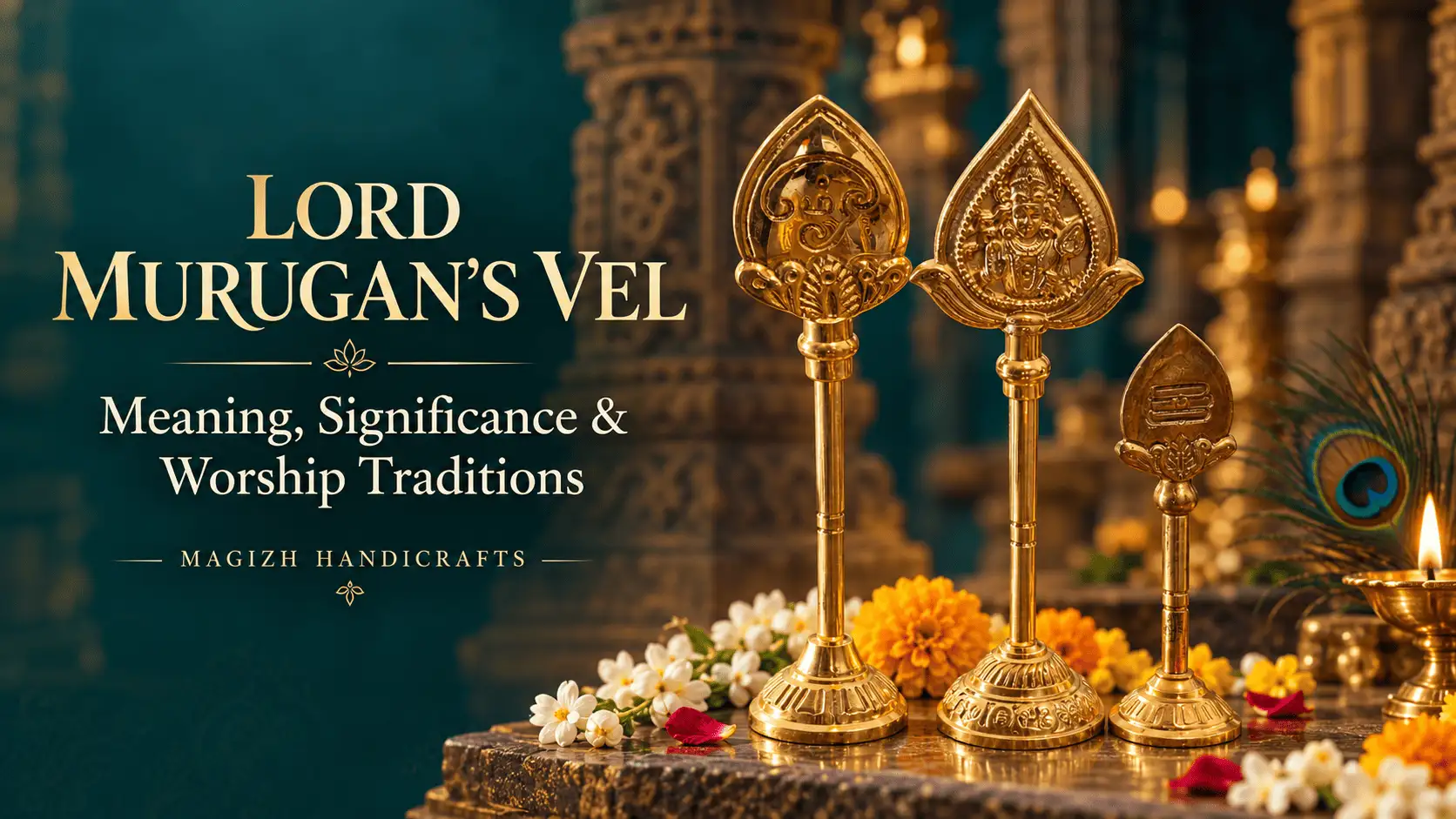
A gleaming Vel beside a Murugan idol is a familiar sight in Tamil homes and temples. For devotees, this sacred spear carries meanings that reach beyond the battlefield: wisdom that dispels confusion, courage guided by compassion, and faith in divine protection.
Understanding Lord Murugan Vel Significance brings these meanings into focus. Why did Goddess Parvati give Murugan the Vel? How does it connect with Surapadman, the peacock and Kanda Sashti?
This guide explores the traditions behind the Vel and offers practical ways to honour it within a thoughtful home pooja arrangement.
What Is Lord Murugan's Vel?
Vel is the Tamil word for a spear or lance. In Murugan worship, it refers particularly to the sacred spear closely associated with the deity.
Its pointed blade and long shaft make it immediately recognisable in devotional art. Yet its importance comes from the relationship between the object, Murugan’s sacred narratives and the devotee’s understanding.
Murugan’s names reflect this connection. Velavan identifies him with the Vel, while Velayudhan refers to the one whose weapon is the Vel.
A physical Vel may be fashioned from metal and placed on a stand. Devotionally, it can serve as a focus for remembering Murugan’s wisdom and grace. Some traditions honour the Vel independently as a sacred representation of his presence.
Who Gave the Vel to Lord Murugan?
In widely followed Murugan traditions, Goddess Parvati gives the Vel to her son for his confrontation with the asura Surapadman.
The expression Shakti Vel connects the spear with Shakti, the Goddess’s divine power. Devotees understand this gift as a mother’s blessing and the empowering presence of the Divine Mother accompanying Murugan.
The narrative also gives the Vel an ethical meaning: strength becomes purposeful when directed towards restoring righteousness.
Accounts differ across religious texts, temple traditions and regional retellings. The Parvati–Vel association belongs to sacred tradition; its details should not be presented as a single, historically documented event.
Lord Murugan Vel Significance: Its Spiritual Meaning
The Vel as a Symbol of Wisdom
The Vel is associated with spiritual understanding and the removal of ignorance. Its penetrating point offers a useful devotional image for clear insight cutting through confusion.
This symbolism invites reflection: learning becomes valuable when it helps a person recognise harmful habits, question pride and act thoughtfully. Saivite teachings explicitly connect Murugan’s Vel with wisdom and freedom from ignorance.
The Vel as a Symbol of Courage
Murugan’s sacred spear also suggests the courage to fulfil responsibilities.
In everyday life, devotees may relate this to speaking honestly, remaining disciplined or facing uncertainty without abandoning their values. Courage here includes patience and self-control, alongside determination.
The Vel as a Symbol of Protection
Many devotees pray to Murugan and his Vel for protection and reassurance. Such prayers express trust in divine grace, especially during difficult periods.
These are devotional beliefs, rather than guarantees that possessing a Vel will prevent illness, loss or hardship. Worship can accompany responsible decisions and practical care.
The Vel as a Symbol of Victory Over Evil
The Lord Murugan Vel victory symbolism arises from Murugan’s confrontation with Surapadman.
Devotees also interpret that struggle inwardly: arrogance, anger and ignorance can disturb one’s judgment. Remembering the Vel encourages awareness of these tendencies and the effort required to overcome them.
For a home shrine reflecting these meanings, Explore Traditional Brass Murugan Idols.
Why Is the Vel Important in Soorasamharam?
Soorasamharam is the ritual enactment commemorating Murugan’s defeat of Surapadman. It forms the climactic observance of Kanda Sashti at temples following this tradition.
In a familiar narrative, Surapadman assumes different forms during the conflict, eventually becoming a great mango tree. Murugan splits the tree with his Vel. The story then connects Surapadman with the peacock that becomes Murugan’s mount and the rooster associated with his banner. Details of the transformation vary between tellings. BiblioAsia
Devotional interpretations give this conclusion particular depth. The defeated adversary becomes connected with divine service, allowing the story to express transformation and grace alongside victory.
Read inwardly, Soorasamharam encourages devotees to confront pride and destructive behaviour. Its sacred drama gives visible form to a struggle that can also take place within the individual.
The Significance of Lord Murugan Vel and Mayil in Murugan Worship
Mayil means peacock in Tamil. It is Murugan’s familiar mount, or vahana, and frequently appears beside him in temple sculpture and household devotional art.
Together, the Vel and Mayil create an immediately recognisable expression of Murugan devotion. The spear emphasises insight and purposeful strength; the peacock adds another layer of symbolism.
One devotional interpretation understands the peacock as pride brought under spiritual discipline. This is an interpretive tradition, rather than the only meaning assigned to the bird. Middle East Institute
Vel and Mayil motifs also appear in brass devotional objects because they communicate Murugan’s identity through familiar forms. Their presence can make a small household arrangement meaningful without requiring an elaborate display.
Why Do Devotees Worship the Vel?
For devotees who honour the Vel separately, it provides a concentrated focus for prayer to Murugan.
Customary practices may include offering flowers, lighting a lamp, reciting hymns or joining temple worship. Festival observances can bring additional rituals particular to a temple or community.
A simple act of placing flowers before the Vel may hold deep meaning for one family; another may follow a fuller inherited pooja routine.
These differences reflect living devotional traditions. The number of offerings or accessories does not determine the sincerity of worship.
How to Perform Simple Lord Murugan Vel Pooja at Home
A modest arrangement can support regular prayer. The following is an optional starting point, rather than a compulsory procedure.
Choose a clean, stable space. Use a secure shelf or pooja platform with sufficient room for worship and cleaning.
Place the idol or Vel safely. A freestanding Vel needs a suitable base. Keep pointed objects away from children and positions where they could fall.
Arrange customary offerings. Fresh flowers, fruit or water may be offered according to family practice. Jasmine and other locally available flowers can keep the arrangement simple.
Light a suitable lamp, if practical. Place it on a heat-resistant surface, away from curtains, garlands and loose clothing. Keep adequate space between the flame and surrounding objects, and never leave it unattended.
Recite a familiar prayer. Devotees may choose a Murugan hymn, a portion of Tiruppugazh or Kanda Sashti Kavasam. Beginners can also pray sincerely in their own words.
Conclude quietly. Spend a moment expressing gratitude and reflecting on an intention such as patience, kindness or clearer judgment.
Bathing an idol is not necessary for this simple routine. Before applying water, milk or other substances, confirm that the item’s material and finish permit it.
For arrangements following your family’s customs, Discover Traditional Brass Vel and Mayil Pooja Items at Magizh Handicrafts.
Lord Murugan Vel and Its Connection to Important Festivals
Kanda Sashti
Kanda Sashti is a six-day devotional observance associated with Murugan’s victory over Surapadman.
Prayer, hymn recitation, temple visits and fasting according to individual custom may form part of its observance. Soorasamharam gives public expression to the victory narrative, placing the Vel at its centre. murugan.org
Thaipusam
Thaipusam is strongly associated with Murugan receiving the Vel from divine Shakti.
Its emphasis on devotion, vows and thanksgiving gives the sacred spear a prominent place. Practices such as carrying paal kudam, or milk pots, and kavadi vary between communities. They are not requirements for every devotee. BiblioAsia
Vaikasi Visakam
Vaikasi Visakam celebrates Murugan’s divine birth or manifestation in devotional tradition.
The occasion brings attention to the deity as a whole: his sacred form, stories and teachings. The Vel remains relevant as one of his most familiar identifying symbols, although the festival’s central emphasis differs from Soorasamharam. murugan.org
Other Murugan Worship Occasions
Monthly Sashti and Krittika star observances are important in many Murugan traditions. Some families also reserve Tuesdays for Murugan prayer.
Local temple festivals, pilgrimage customs and household observances add further variety. Festival timings should follow the relevant local calendar and temple announcements.
The Vel in Tamil Literature, Temples and Devotional Traditions
Murugan occupies a prominent place in Tamil religious life, expressed through poetry, pilgrimage, music and temple worship.
Arunagirinathar’s Tiruppugazh is a celebrated body of devotional songs praising Murugan. Kanda Sashti Kavasam, composed by Devaraya Swamigal, is another widely recited Tamil hymn associated with prayers for divine protection. These works belong to distinct literary settings and should not be treated as interchangeable texts. Hinduism Today
The devotional call “Vel Vel Muruga” invokes Murugan through his sacred spear. For many families, such expressions are first encountered through elders, temple processions or songs heard at home.
Murugan’s iconography also varies. The Vel is central to many forms, while Palani’s Dandayuthapani form holds a staff. Recognising these differences deepens appreciation of the tradition’s richness. BiblioAsia
Choosing a Traditional Brass Vel or Murugan Idol for Home Worship
The most suitable item is one that fits the household’s space, routine and traditions.
Consider:
Size: Allow room around the item for offerings and cleaning.
Stability: Check the base, balance and supporting surface.
Detailing: Choose a form whose features are clear and meaningful to you.
Maintenance: Understand whether the surface is polished, lacquered, coated or finished to appear antique.
Arrangement: Leave safe clearance around lamps and avoid crowding existing idols.
Brass is appreciated for its warm appearance, durability and ability to carry detailed designs. However, brass is not a universal religious requirement.
A smaller, securely placed item can serve a household better than a larger piece that is difficult to maintain.
For suitable options, Explore Brass Murugan Idols and Pooja Accessories at Magizh Handicrafts.
How to Care for Brass Vel and Murugan Pooja Items
Dust regularly with a clean, soft cloth. Support the item securely while cleaning, taking care around the Vel’s point, peacock feathers and other delicate details.
Avoid prolonged moisture. Where washing is appropriate for the finish, dry the item thoroughly, including recesses and the underside of the base.
Cleaning methods must suit the actual surface. A treatment intended for plain, uncoated brass may damage lacquer, decorative coatings or an antique finish.
Do not apply acidic household mixtures or harsh abrasives universally. Follow the seller’s care guidance, and test an approved cleaner on a discreet area when appropriate.
Remove wilted flowers and offering residue promptly so that the pooja space remains clean and easy to maintain.
Frequently Asked Questions About Lord Murugan's Vel
1. What does Lord Murugan Vel symbolize?
The Vel symbolises wisdom, courage, divine protection and victory over harmful forces. Devotees also understand it as a reminder to overcome ignorance and approach life with disciplined judgment.
2. Who gave the Vel to Lord Murugan?
In widely followed devotional traditions, Goddess Parvati gives Murugan the Vel as an expression of her divine Shakti. Details differ across regional narratives and religious traditions.
3. Why does Lord Murugan carry a Vel?
The Vel identifies Murugan’s role in confronting forces opposed to righteousness. Its devotional meaning also connects his strength with spiritual insight, rather than physical power alone.
4. What is the meaning of Vel and Mayil?
Vel means spear, and Mayil means peacock. Both are closely associated with Murugan: the Vel is his sacred weapon, while the peacock is his familiar mount.
5. Can we keep a Murugan Vel at home?
Yes, many devotees keep a Vel in their home pooja space. Choose secure placement and follow your family’s customs. Particular inherited or consecrated items may have specific care traditions.
6. How can devotees worship Murugan's Vel at home?
A simple practice may include flowers, a safely placed lamp, a familiar hymn and personal prayer. Elaborate offerings are unnecessary for a modest daily routine.
7. What is the connection between Vel and Kanda Sashti?
Kanda Sashti commemorates Murugan’s victory over Surapadman. The Vel is central to that narrative and to the Soorasamharam enactment associated with the observance.
8. Is a brass Vel suitable for a home pooja arrangement?
A brass Vel can be suitable when its size, base and finish match the intended arrangement. Consider stability and maintenance, and remember that the material itself does not determine devotional value.
Conclusion: Understanding the Devotional Meaning of Lord Murugan Vel
Lord Murugan Vel Significance brings together sacred narrative, Tamil cultural memory and personal devotion. The Lord Murugan Vel wisdom that challenges ignorance, courage guided by purpose, and the possibility of inner transformation.
At home, these meanings can be honoured through a simple, well-maintained pooja space and regular moments of prayer. Understanding, devotion and family traditions matter more than the size or material of a worship item.
Magizh Handicrafts is a Chennai-based retailer of devotional idols and traditional pooja accessories for such household arrangements.
Explore Lord Murugan Vel Collections at Magizh Handicrafts: www.magizhhandicrafts.com.